



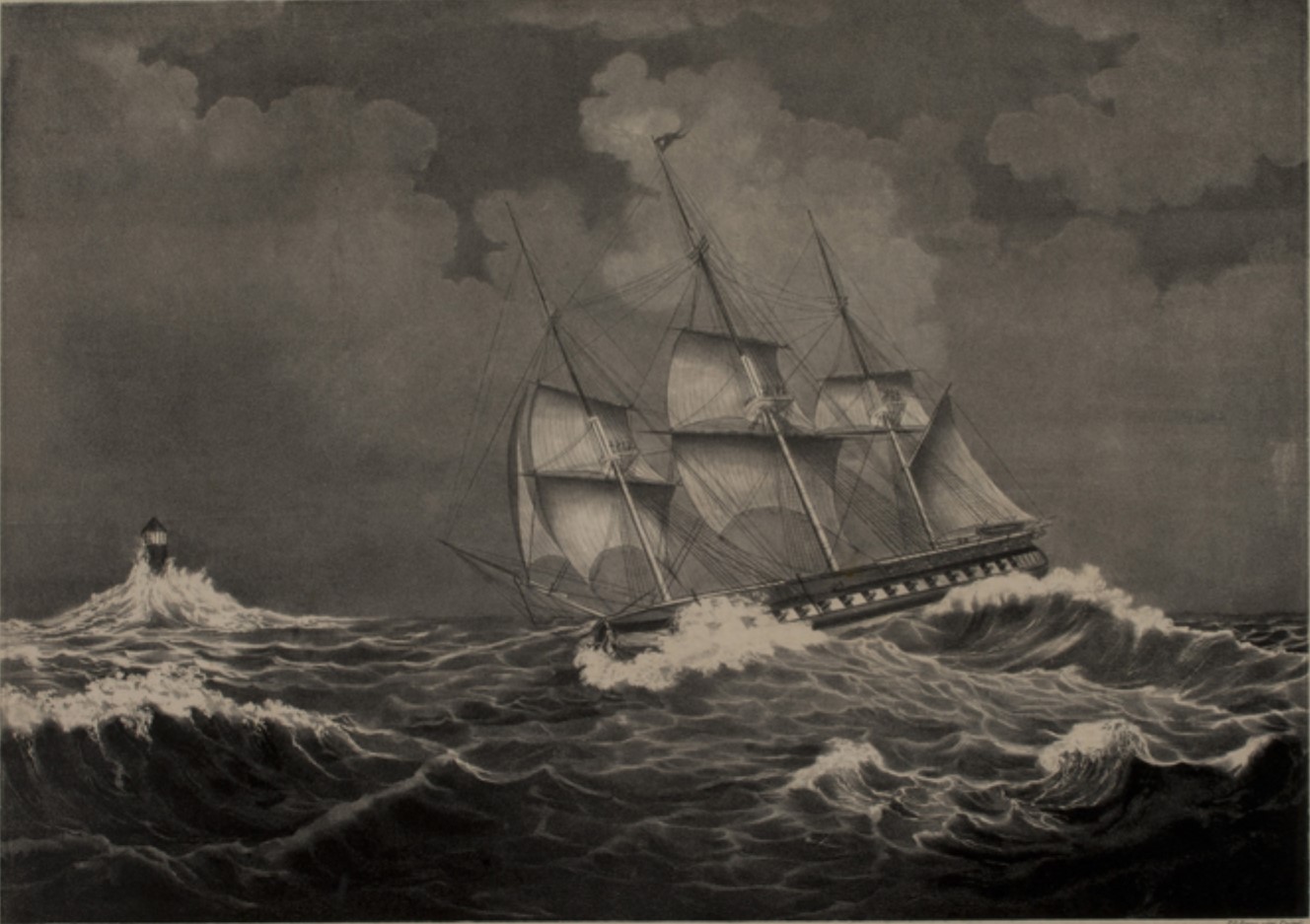
Christmas Eve of 1803 started off nicely for the crew of USS Constitution. Stationed off the coast of Tripoli in the Mediterranean Sea, Constitution had just the day before seized the Mastico, a valuable merchant ship that would later play a pivotal role in the Barbary War. Early on the morning of Christmas Eve day, Constitution was sailing back toward Tripoli in nice weather.
But before noon, dark storm clouds began moving in from the northeast, accompanied by growing wind from that direction. Given the ship’s location off the North African coast and the prevailing conditions of storms in the area, the change did not bode well for the ship or its crew. By nightfall a horrific storm threatened to drive the ship into a corner of the coast where there was no open sea to run with the wind. If they could not make ground sailing against the wind, the ship would be driven ashore and wrecked. But setting too much sail in the howling squalls threatened to dismast the ship, destroying any prospect of escape.
For the entire night and throughout Christmas day, the crew worked non-stop to save themselves and their ship. Their efforts, recounted in the ship’s log and officers’ journals, cast a poignant light on the difficulties of life under sail, as well as the Herculean tasks that were sometimes required to keep a ship both safe and moving in the right direction during heavy weather.
A Precarious Position
Early on Christmas Eve afternoon, Sailing Master Nathaniel Haraden identified the shifting wind direction, its likelihood to grow in strength, and what it meant for Constitution. “A heavy gale from the NE or NNE would make our situation very disagreeable,” Haraden wrote in his copy of the log. “It would expose us to an Enemys Coast, the angular position of which to the northward and westward makes it necessary to avoid that part…”
West of the city of Tripoli, the North African shoreline turns north for more than 100 miles. Most of the time prevailing winds come off the desert from the south. The main sea current flows from west to east, but at the turn in the coastline, a nearshore current funnels water northwest along the shoreline. When winter storms from the northeast blow down across the Mediterranean, the change in wind direction pushes more water with it, strengthening the current flowing northwest along the shoreline. For USS Constitution, all of this meant potential disaster. If the ship could not manage to make its way safely east and north before and during the storm, it would be swept by wind as well as current onto the coast.
![Detail of a modern U.S. nautical chart of the Mediterranean Sea, north and west of Tripoli. [National Geospatial Agency chart 310]](https://ussconstitutionmuseum.org/wp-content/uploads/2025/12/USSC-Xmas-1005x1024.jpg)
“A heavy gale of wind from the N. E. in danger of being lost on the coast of Tripoli,” Captain Edward Preble wrote, matter-of-factly in his personal memorandum book.
But running aground on the Tripolitan coast meant more than possibly losing the ship. The crew, assuming they survived the wreck, would be captured by the Tripolitans, a fact Preble and his officers were acutely aware of.
“The Horrors of ship wreck added to irretrievable Slavery make the coast very dangerous in the winter,” Haraden wrote.
Turning into the Weather
Sailboats and sailing ships cannot sail directly into the wind, so to make their way in the direction from which the wind is coming, they must sail at an angle and zig zag or “beat” their way to windward. For a square-rigged ship like Constitution, the closest they can sail to the wind may be 60° or 70° away from the direction it’s coming from, depending on the conditions. Each direction change in the zig zag requires the ship to “tack” or turn its bow through the eye of the wind – during which it can blow backward, losing ground.
It’s common for ships beating in bad weather to make little or no forward progress or even be pushed further downwind despite the effort. These circumstances mean that a “lee shore,” having the shore downwind (to “leeward”) is particularly hazardous.
When it was clear that a storm was coming, Constitution turned away from Tripoli and started steering to the east-northeast, the most northern course the ship could manage, and sailing under “all plain sail,” everything but the particularly specialized light wind sails. Though they could no longer see the shore, Haraden estimated the ship was about 24 miles from Tripoli at noon.
Adjusting Sails and Rigging
By 6 p.m., the first bands of rain began rolling in, accompanied by shifting bursts of winds. In the rigging, the crew were double reefing the topsails, dramatically reducing the exposed sail area of the ship’s primary powerhouse sails. Above them, not only were the lighter, higher sails furled, but the yards the sails hung on were sent down to the deck to prevent them from breaking in the intermittent squalls.
Throughout the night, the crew reduced the ship’s sail area with each approaching squall line and reset the sails after the squall passed. The men working aloft in the rig during the midnight watch were likely up there for hours in the dark wind and rain, while the crew on the deck repeatedly hauled the lines that lifted and dropped the sails. According to Haraden, the mainsail and topsails were clewed and reset three times during the watch.
![Depiction of "Old Ironsides on a Lee Shore," engraved by A. Hoffy after a painting by J. Evans. Published by Duval & Dow in Philadelphia, Pennsylvania, 1839. [Courtesy of the Navy Art Collection.]](https://ussconstitutionmuseum.org/wp-content/uploads/2025/12/USN482-1-excerpt-1024x723.jpg)
At dawn, the ship continued to pitch back and forth as it plowed into the oncoming waves of the storm. To prevent the strain on the rig, the fore and mizzen topgallant masts, 48-58 feet long and averaging 10 inches in diameter, were lowered, and the jib booms extending from the bowsprit were brought inboard. To take the strain off the bowsprit, the crew rigged a “belly stay,” a massive cable running from the middle of the fore topmast to the bow of the ship.
Throughout Christmas morning, the squalls continued. Haraden wrote that the crew furled then reset the topsails two or three more times before noon.
Success and Back to Business
At 10 minutes before noon, the sun came out, allowing the officers to determine the ship’s latitude for the first time since the storm began. Their observation confirmed what they suspected. The ship was approximately 40 miles further north of Tripoli than when the storm began. Their immense effort had succeeded, but the storm was not over.
The heavy wind continued through Christmas day, not moderating until around midnight. By then, the sea was finally growing smoother too, Haraden wrote, and the crew set to work rerigging the upper masts, yards, and jib booms.
At sunrise on December 26, the lookout spotted sails of two ships on the horizon. Resetting more sail in the brightening weather, Constitution joined the chase to intercept them.
The Author(s)
Carl Herzog
Public Historian, USS Constitution Museum
Carl Herzog is the Public Historian at the USS Constitution Museum.


