



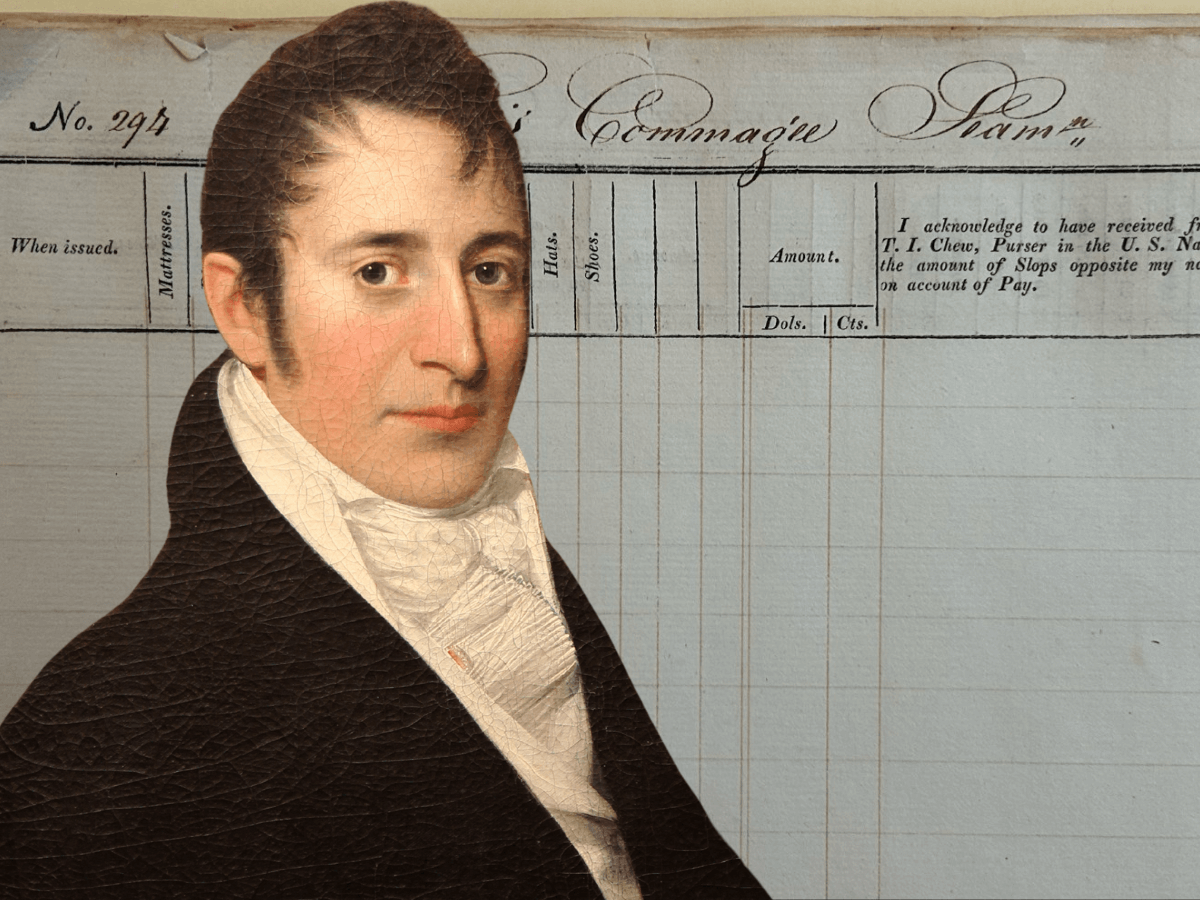
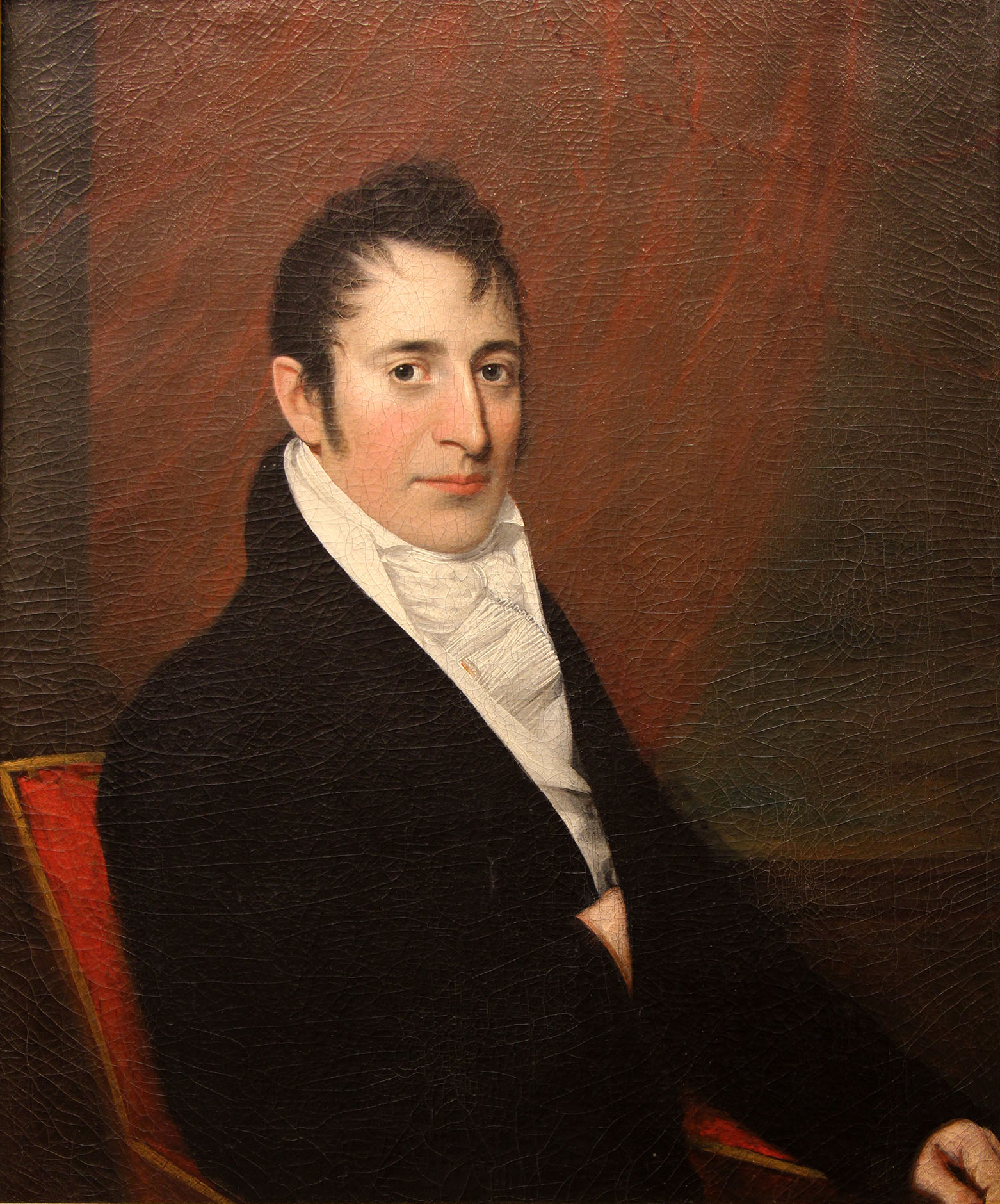
Thomas Chew was an entrepreneur and investor who earned a lucrative living that supported the purchase of luxury goods, allowed him to support his family, and even regularly loan money to extended family and friends.
This was made possible by a profitable career as a U.S. Navy purser. For more than 20 years beginning in 1799, Chew served on board a wide range of ships and naval bases, including service on USS Constitution during the War of 1812. Like many Navy pursers, he likely earned more than most of the ship captains he served under.
Business Agent, Paymaster, Grocer, and Shopkeeper
Pursers held the purse strings on board navy ships, allocating resources, managing money, and fulfilling the complicated bookkeeping required by the federal government. Like the rest of the crew, pursers were paid a monthly wage and shared in the prize money from enemy captures. However, unlike other positions, pursers had the unique privilege of nearly unlimited earnings on board. Pursers were responsible for supplying the crew with “slops,” a catch-all term for anything a crew might need or want on board during a cruise, including items like clothing, soap, tea, and tobacco. The purser was allowed to provide many of those supplies at a markup that went directly into the purser’s own pocket.
No cash was exchanged at the time of the purchase, but the purser kept records of each crew member’s credit line. When the crew was paid off at the end of their service, the purser deducted the crew member’s spending from his paycheck.
In addition, pursers often paid themselves a commission on other transactions they handled for the Navy while on station in ports or shipyards. As part of their management of ship’s money, they were often responsible for allocating earned prize money to ships’ crews and often earned their own 5 percent commission for doing so.
A separate prize agent was occasionally hired by the Navy to distribute prize money. This was the case in USS Constitution’s victory over HMS Guerriere, but the prize agent still had to depend on Thomas Chew’s accounting of exactly who was on board the ship in what capacities at the time of the victory.
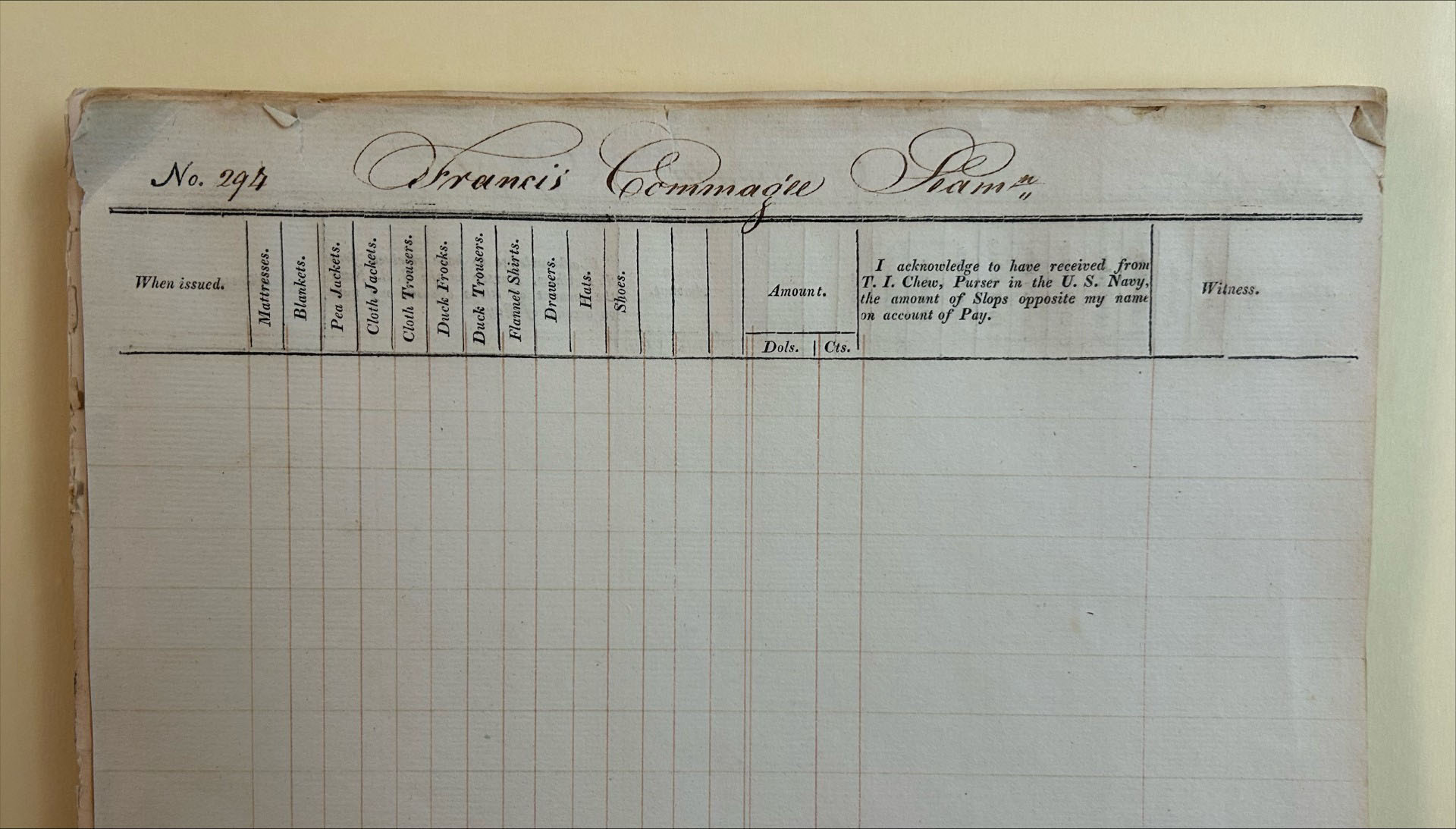
All of this was tracked through a complex set of ledgers that had to be meticulously maintained. This was a daunting task that many pursers failed at, resulting in unaccounted losses. Chew meticulously recorded his accounts using custom pre-printed ledgers to track every crew member’s purchase and all other monetary transactions and distributions. Once a voyage was over and the accounting resolved without issue, many of the more detailed records were not preserved. As a result, very few comprehensive records remain of what sailors specifically bought, or what the pursers earned from individuals and other transactions.
Slops
Slops were divided into three basic categories: clothing, “articles of second necessity,” and luxuries.
Basic clothing such as shirts, jackets, trousers, drawers, socks, shoes, hats, and handkerchiefs were considered essential goods on which the purser was expected to make no profit. The Navy attempted to supply these necessities in bulk, purchased by naval agents in port and transferred to the purser for distribution to the crew during the voyage. The purser was, however, allowed to charge 12-15 percent mark-up to ostensibly cover the Navy’s losses from damage to the inventory in the ship’s hold. Occasionally, additional clothing was purchased by the purser at his own expense in other ports or from other suppliers, creating another avenue for profit.
“Articles of second necessity” included toiletries, utensils, knives, ribbon, needles, thread, mustard, and chocolate. Regulations allowed the purser to make a 25 percent commission on these sales.
Luxuries, including coffee, tea, sugar, and tobacco, could be sold at a 50 percent markup. Because food was easily pilfered or spoiled before sale, pursers received an additional 5 percent bonus.
Naval agents onshore supplied many required goods, but pursers purchased an additional inventory of items at their own discretion. It was a purely entrepreneurial side hustle. With a captive market of more than 400 crew members for months at a time, a savvy purser like Chew who anticipated a crew’s desires could finish a cruise with extraordinary personal profit. Conversely, sailors who failed to curb their spending could end the voyage with little or no pay, or even in debt to the purser.
Attempts at Regulation
The Navy recognized the potential for abuse by pursers and attempted to restrain their authority through regulation. But shipboard environments were difficult to manage from shore, and pursers frequently appealed for exceptions based on the particular demands or location of their ship’s service. In 1809, the Navy issued specific regulations to control pursers’ activities. It forbade commissions on specific transactions and limited markups on slops.
Though inconsistently followed and enforced, 1809 regulations still allowed pursers to earn far more than any other crew member, including the captain. When the proposed regulations were being debated, Captain John Rodgers prepared a detailed estimate of a purser’s profits before and after regulation on just the sale of luxuries and articles of second necessity.
Rodgers estimated that, on an average two-year assignment aboard a frigate like Constitution without regulations, a purser could earn a profit of $42.86 from each crew member on board. Multiplied by a 400-man crew, the purser could profit more than $17,000 during the voyage. Even accounting for a five-percent loss on damage and spoilage of goods, the purser was still making about 30 times his wages from just the sales of these two categories of slops. With the proposed regulations in place, Rodgers estimated the purser could still earn more than $5,000 in profit, or about 10 times his wages.
Inherent Risks
The purser’s hustle was not without risk, however. There are numerous accounts of pursers who failed to sell their supply or suffered other catastrophes on board that resulted in significant or even total losses.
Purser John Timberlake served on board USS United States during its victory over HMS Macedonian in October 1812. The ship returned to a hero’s welcome in New York, which included a celebratory dinner ashore for the entire crew. However, many of the crew who ended the voyage in debt took the dinner as an opportunity to desert the ship and skip out on the money they owed. As a result, Timberlake was left in arrears.
In January 1815, Timberlake was purser on USS President as the ship attempted to break the British blockade of New York Harbor. While fleeing, the crew jettisoned cargo to lighten the ship’s load, including the purser’s personal stores. When President was captured by HMS Endymion, Timberlake also lost his accounting records detailing what each sailor owed. After returning to shore, Timberlake was ordered to settle the crew’s wages. Without his accounting records, he was forced to pay every sailor in full and absorb the loss for goods he had sold. Timberlake continued to serve as a Navy purser until succumbing to illness in 1828 while serving on USS Constitution.
The Author(s)
Carl Herzog
Public Historian, USS Constitution Museum
Carl Herzog is the Public Historian at the USS Constitution Museum.


