



In 1824, USS Constitution returned to the Mediterranean for a four-year squadron assignment. The ship had been in the region from 1821 to 1824 before returning to Boston for a short refit and replenishment. The goal of the prolonged presence was to protect U.S. trade and interests, but, particularly in 1824, Constitution was sailing into a confluence of ancient conflict and modern foreign policy debate in which U.S. positions were precariously balanced.
Greek nationals began revolting against the Turkish Ottoman Empire, which had controlled Greece for nearly 400 years, in 1821. By the time Constitution arrived in 1824, the revolt had reached something of a stalemate, with neither side able to decisively defeat the other – a situation that would last until 1829. As the revolution wore on, public opinion in the United States had grown strongly in favor of supporting Greece, popularly seen as the ancient birthplace of democracy and romanticized as an inspiration for America’s founding fathers during the American Revolution.
But U.S. trade was deeply entwined with the Ottoman Empire. Opposing voices in Congress urged restraint, arguing against involvement in what was widely viewed as a European conflict. They maintained that the United States should adhere to the principles of the Monroe Doctrine enacted in 1823, which committed the nation to avoiding entanglement in European affairs.
For the crew of USS Constitution deployed to the Mediterranean, all this meant largely standing by to protect U.S. merchant ships from threats by either side. Greek pirates had begun raiding U.S. merchant ships trading with the Turks, but the U.S. Navy’s response was largely protecting merchants in convoys and hunting down captured U.S. ships to repatriate them. While the government did not sanction direct involvement in the conflict, Constitution’s second Mediterranean deployment during the Greek War of Independence included hosted visits from Greek military leaders, intervening to assist American citizens who were privately assisting the Greeks, and even taking on Greek refugees.
William Fleming, a U.S. Marine serving on Constitution, detailed the ship’s activities in a personal journal¹ he kept throughout the 1824-1828 squadron duty. His descriptions show the American admiration for the Greek leaders and personal support for the Greek cause.
Visit from Greek Admiralty
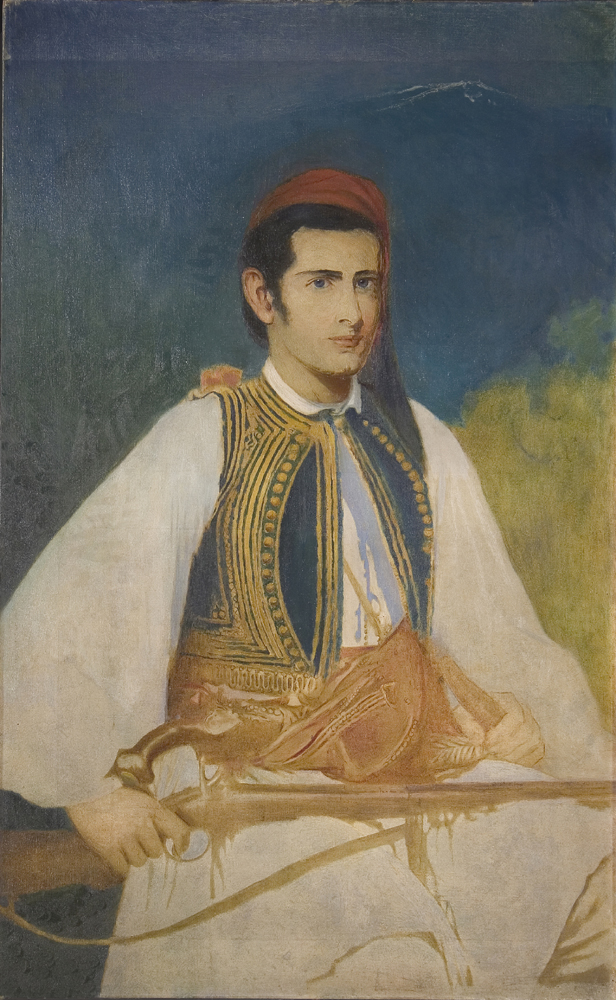
On May 11, 1827, Constitution arrived at the Greek island of Aegina near Athens, used by the Greek Navy as a rendezvous point. Four Greek brigs were in the harbor when Constitution arrived, and the ship soon hosted a visit from the Greek Admiral Konstantinos Kanaris (Constantine Canaris). Kanaris was known for his use of fire ships to destroy Turkish warships, and in 1822 had gained fame for destroying the Turkish flagship in a fire attack.
“He is a man of about 35 years of age, of small stature, but well made, with dark penetrating eyes, and of a very mild, modest deportment,” Fleming wrote in his journal, describing Kanaris. “He is one of the bravest men that the Greeks possess, and his gallant exploits have rendered his name dear to his countrymen.”
Following the war, Kanaris went on to become prime minister of Greece five different times during the new nation’s turbulent early politics. He died in office in 1877.

A Refugee in the Navy
On May 14, Constitution picked up several Greek refugee boys who were enlisted onto the crew of the ship. Among them was George Sirian, who was orphaned in a massacre of his town. He stayed on board Constitution, first at the rank of boy, then promoted to ordinary seaman before the ship returned to Boston in the summer of 1828. With the sponsorship of a lieutenant on board, Sirian trained to be a gunner under the instruction of George Marshall, a naval gunner of Greek origin himself who had written the pre-eminent textbook on naval gunnery at the time. Sirian continued to serve in the U.S. Navy until 1880, in what remains one of the Navy’s longest enlisted careers.

Helping Howe
Two weeks after visiting Aegina, Constitution was summoned to Nafplio to assist with a shipment of provisions from the United States intended to relieve the growing Greek famine caused by the war. The shipment was arranged by Bostonian Samuel Gridley Howe from private funds he raised from Greek support organizations in the United States. A graduate of Harvard Medical School, Howe traveled to Greece in 1824 and served as a surgeon for the Greek military. Upon his return to the United States, Howe launched a drive to raise money for provisions and supplies for the embattled Greeks.
However, when Howe arrived with two ships of provisions, he was prevented from distributing the aid. According to Fleming’s account, after Howe called for help from Constitution, Captain Daniel Todd Patterson went ashore to resolve the issues and see the aid distributed.
Howe continued to raise funds and orchestrate shipments of provisions and supplies to Greece through the end of the war. In the 1830s, he founded the Perkins School for the Blind in Boston. He was an anti-slavery activist in the decades leading up to the American Civil War and was married to Julia Ward, author of the Battle Hymn of the Republic.
Europe Joins the Fight
While the United States had decided to stay militarily neutral in the conflict, other European nations did not. Egypt pledged support for the Ottoman Empire, and in 1826, France, Britain and Russia agreed to join forces in support of Greece, sending naval squadrons to the region.
In 1827, the Greek allies destroyed the Ottoman-Egyptian fleet at Navarino in what would turn out to be history’s last battle fought exclusively by sailing ships. Fleming reported that Constitution’s crew learned of the victory, though Constitution was on the other side of Greece at the time.
The victory at sea opened the door for Greek victory overall, though the conflict continued until September 1829, when a final land battle drove the Turkish forces from the region.
___________________
Sources
¹William Fleming’s journal is in the collection of Naval History and Heritage Command Detachment Boston.
The Author(s)
Carl Herzog
Public Historian, USS Constitution Museum
Carl Herzog is the Public Historian at the USS Constitution Museum.


