



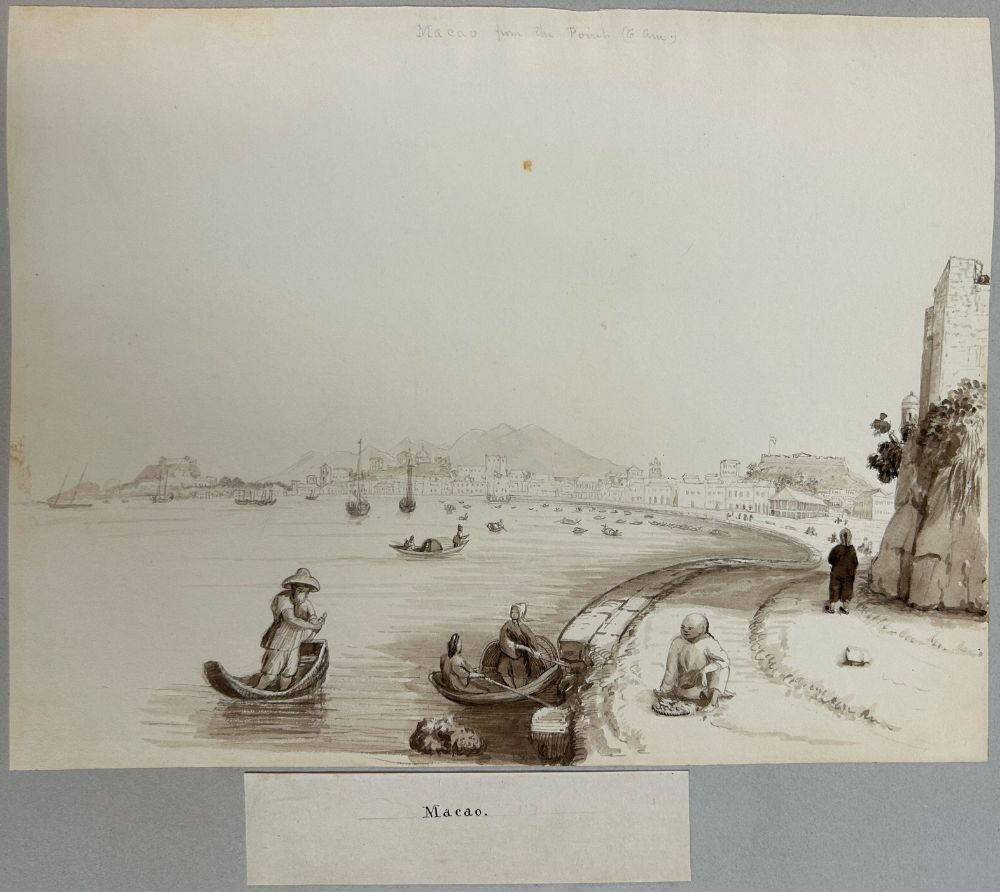
At the water’s edge on the harbor of Macao, two women in a small sampan are pushing off from a landing at the seawall. A few feet away a man standing in a boat that is shorter than he is tall waits for the women to make space for him to come ashore. He’s been waiting for more than 180 years, yet they all seem perpetually in motion.
Rendered in ink in June 1845 during USS Constitution’s visit to the port, the figures in the foreground of Lieutenant John Blake Dale’s sketch of the harbor of Macao appear to float on the page, instantly capturing the viewer’s attention. But the shoreline they are vying for curves off into the distance forming the historic harbor that is the real focus of Dale’s landscape sketch. Along the waterfront and up the hills in the distance are the colonial buildings and fortification of the old Portuguese trading center. On the water, European and American trading ships at anchor contrast with the myriad sampans going about their business.
“The sun pound down its beams with a terrible intensity into this little cove,” Dale wrote of his visit in his journal, “yet we could enjoy the picturesque beauty of the town – old grey walls and fresh green foliage – the union of European and Asiatic appearances, costumes, chinese with their basket-hats and long tails, Europeans in white jackets, and Parsees in their peculiar tall caps and snowy costumes.”¹
In a career cut tragically short by an early death, Dale’s work hints at the talents that made him eminently valuable in his time. As a U.S. Navy midshipman and lieutenant in the 1830s and 1840s, Dale was deployed on numerous Navy squadrons and voyages of exploration to lesser visited ports around the world. By the time he joined USS Constitution’s circumnavigation of the globe from 1844 to 1846, Dale had already circled the world on another Navy expedition.
He produced dozens of sketches of people and landscapes wherever he went, but he also generated highly detailed, hand-drawn navigational charts for both the Navy and merchant shipping. Assigned to the U.S. Coast Survey for several years, Dale contributed to hundreds of charts that Navy and merchant ships came to rely on in an era of booming American trade.
A Teenage Cartographer
John B. Dale was born in Springfield, Massachusetts, in 1813 to Samuel and Elizabeth (Lincoln) Dale. They had seven more children after John; two boys and five girls, one of whom died as an infant.
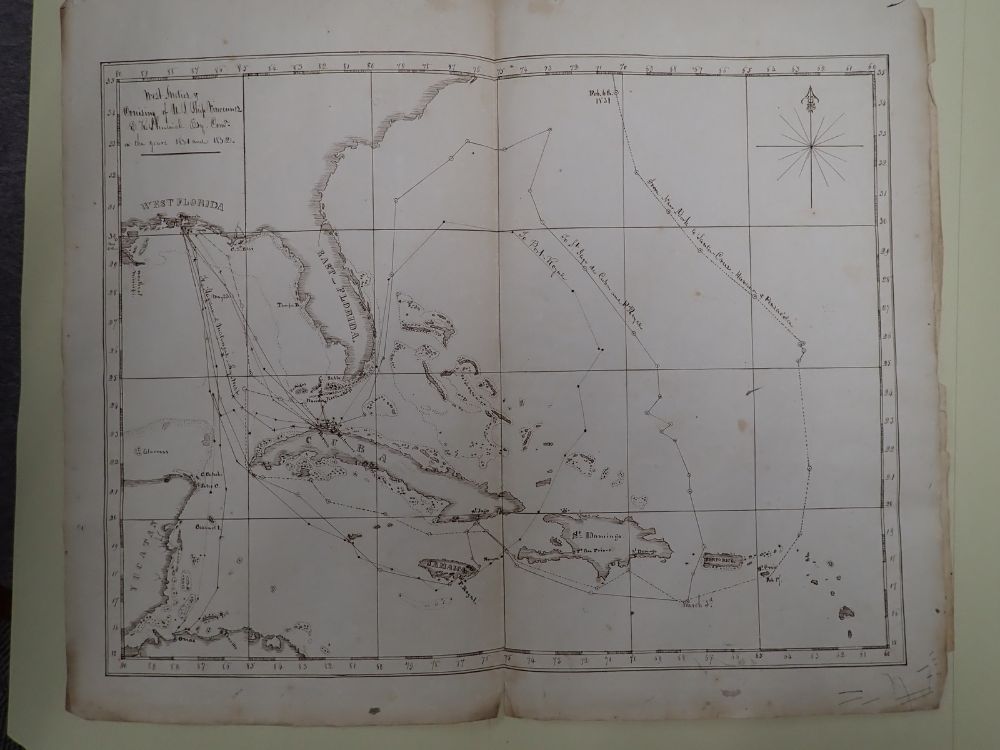
John was appointed a midshipman in the Navy in 1829 at the age of 15 and first went to sea aboard USS Vincennes as part of the West Indies Squadron in the Caribbean. There he demonstrated his early chart-making skills, creating detailed geographic accounts of the ship’s many passages among the islands, all while still in his teens. During the voyage, there was an outbreak of yellow fever on board, and the ship was forced to stay in Pensacola, Florida, in the Gulf of Mexico for nearly a year while the disease ran its course before returning to Portsmouth, New Hampshire.
World Explorer
After a short leave of absence, Dale rejoined Vincennes for its next voyage, heading far into the Pacific and eventually around the world. Among the mission goals was tracking stranded and shipwrecked American sailors across the remote islands. Vincennes became the first American ship to land at Guam during the voyage and continued westward from there to Singapore and through the Malacca Straits to Sumatra and the Indian Ocean. In June 1836, Vincennes arrived back in the United States, having circled the globe for the second time in the ship’s career. It was Dale’s first time, but would not be his last.
Both Vincennes and Dale were next assigned to the U.S. Exploring Expedition. A far-reaching voyage built around surveying and scientific discovery, the expedition included several ships, numerous scientists, surveyors, and cartographers all under the command of Lieutenant Charles Wilkes, whose name became synonymous with the expedition.
Vincennes was the flagship of the ambitious voyage, but Dale was assigned to the USS Porpoise. The expedition’s diverse missions to chart shoals in the Pacific, visit Antarctica, and identify myriad new species of plants and animals everywhere suited Dale’s artistic and drafting skills. Despite this and being promoted to lieutenant during the voyage, he was relieved of duty after facing accusations of incompetence by the contentious Wilkes. Dale was transferred to USS Relief, a slow-moving supply ship that was ordered to return to the East Coast while the rest of the expedition ventured back out across the Pacific.
Returning Home
On his return home in 1840, Dale was appointed to the U.S. Coast Survey. Although formally established by Thomas Jefferson in 1807, the Coast Survey did not begin successful operations until 1832. Its goal was to provide mariners with authoritative nautical charts of the entire U.S. coastline. Until that point, U.S. ship captains relied on privately published charts and navigation books.
Dale spent four years as a cartographer in the Coast Survey, a shoreside job that allowed him to start a family. He married Jane Anne Hutchins Hales on June 10, 1840. A son, William Hales Dale, was born on August 15, 1842, in New Castle, Delaware.
Around the World on “Old Ironsides”
In December 1843, shortly after the birth of his son, Dale was transferred as a lieutenant to USS Constitution, then preparing for its own circumnavigation under Captain John Percival. The ship departed New York in May 1844.
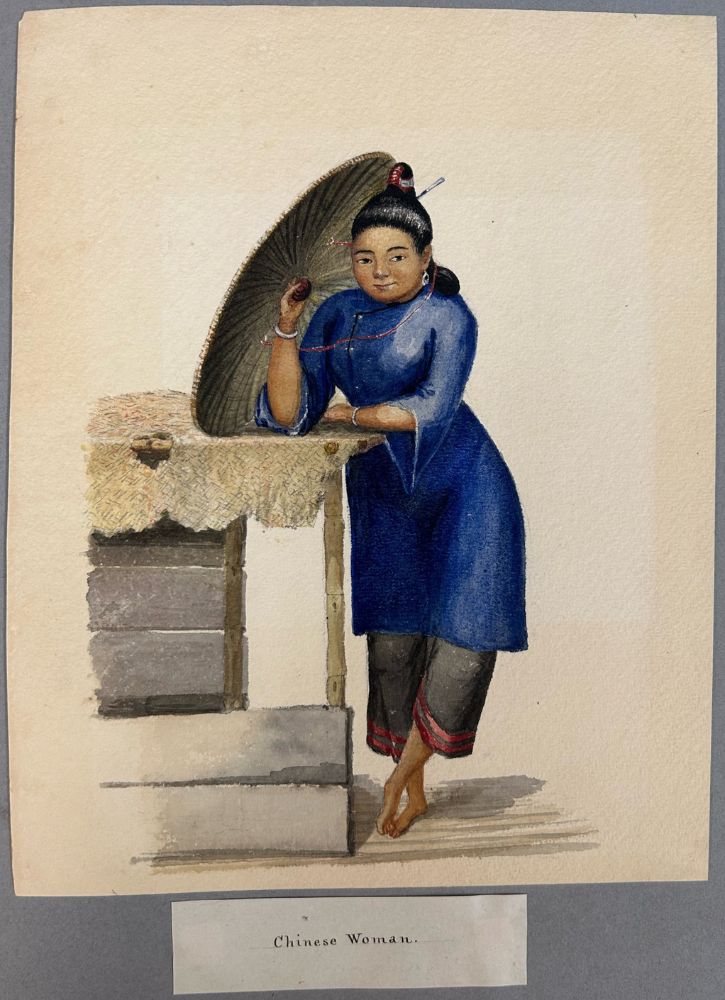
In addition to serving as a deck officer on the voyage, Dale produced charts of some of the harbors the ship visited and created a wealth of artwork depicting the locales and their people. His watercolor and ink artworks from places like Cochin China (Vietnam), Macao, Canton, and the South China Sea showcase the colorful clothing and material culture of places that most Americans at the time had never seen. Dale served aboard Constitution for its entire two-year voyage, returning in April 1846.
A Middle East Burial
Exactly a year after returning from Constitution, Dale again said goodbye to his young family. He was assigned to the Mediterranean Squadron but was detailed to an expedition intended to map the Dead Sea. Dale was second-in-command under William F. Lynch, who was tasked with determining if the Dead Sea was below sea level. The arduous expedition involved dismantling two large metal boats for overland transport across the desert to the Dead Sea.
On July 24, 1848, on the return trip to the coast, Dale died of fever near modern Beirut and was buried there. He was 35 years old. It took two months for word of his death to reach his family. Four months later, his wife, Jane, died of tuberculosis at age 28, leaving behind their six-year-old son, William. William also died at the age of 29 in March 1872.
John Blake Dale’s legacy lives on in his vibrant portraits, detailed landscapes, and hand-lettered nautical charts. His short but prolific career points to the value of his artistic capabilities to the U.S. Navy at a time of exploration and discovery.
___________________
Sources
¹Journals of John B. Dale, Mss 994, R. Stanton Avery Special Collections, New England Historic Genealogical Society.
The Author(s)
Carl Herzog
Public Historian, USS Constitution Museum
Carl Herzog is the Public Historian at the USS Constitution Museum.


