



The American Revolution unfolded on Boston Harbor.
From the Boston Tea Party to the evacuation of British troops and loyalists from the city, Boston Harbor, an early engine of global trade for decades before the Revolution, became the setting for colonial grievances against the Crown, and then turned into a bitterly contested battleground over control of access between land and sea.
During the years of the Revolution the conflict was carried to the other major American ports, but the unique geography of Boston Harbor, the city’s bustling economic port profile, and a population long enmeshed in global maritime trade all contributed to Boston becoming an early flashpoint for war.
Following the Revolution, Boston Harbor remained a critical shipping port that became a base of U.S. Navy operations, including USS Constitution. Built and launched into the harbor in 1797, “Old Ironsides” has called Boston home for most of its 228 years. This year, the ship and the USS Constitution Museum celebrate the 250th anniversary of the nation’s independence, launched from this same harbor.
A Unique Harbor
Boston Harbor is a sprawling place unlike any other port on the eastern seaboard. Part of a prehistoric geological basin wedged between granite formations to the north and south, Boston Harbor spreads out over more than 70 square miles, speckled with dozens of islands left behind by the retreating glaciers. Ships arriving under sail in the 1700s had to pass among the rocky outer islands which gave way to sprawling salt marsh flats at the junctures of numerous rivers, forming even more islands. But the open water among them and relatively short distance to open ocean made Boston more easily accessible than ports like Philadelphia, located far inland up a river. Over the centuries since Boston was settled in the 1600s, thousands of acres of harbor and shoals have been filled in to create new land for seaport and airport facilities, but in the 1770s, the inner harbor remained a broader space ringed by salt marsh flats and shoals.
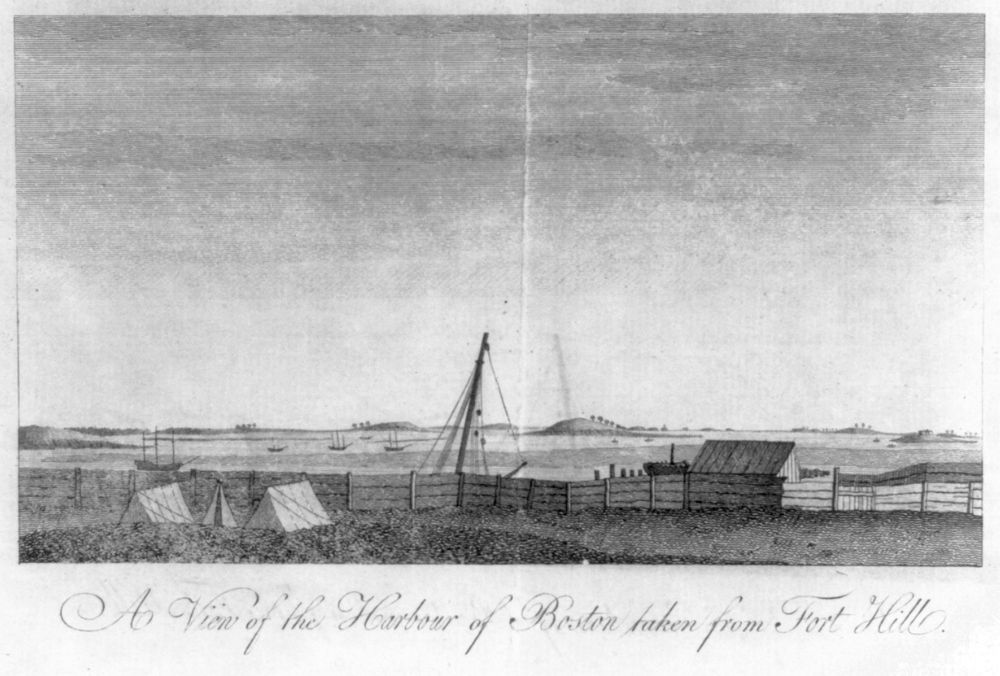
An Early Maritime Power Threatened
That geography contributed to an early bustling economy that made Boston one of the American colonies’ busiest ports. Throughout the first half of the 1700s, colonial merchants from Boston traded extensively with England, along with other European colonies in the Caribbean and other nations in the Mediterranean. British laws were generally designed to restrict colonial trade to the benefit of England, but those laws were largely unenforced until after the end of the Seven Years War in 1763. Burdened by war debt, the Crown began cracking down on tariff enforcement and trade restrictions and introduced new revenue-generating taxes on trade.
Because the colonists had no representatives in Parliament, the new laws raised fundamental questions about the British government’s authority over the colonies. But for Boston’s merchants, mariners, dockworkers, and related maritime trades, the changes threatened industries and an economy built over decades of growing global trade and the freedoms that had allowed that trade to flourish. It is little wonder the earliest sparks of protest came from the waterfront, only to be amplified as workers clashed with British soldiers dispatched to silence the unrest.
The Boston Tea Party
On the evening of December 16, 1773, a group of protesters boarded three East India Company ships in Boston Harbor and dumped more than 92,000 pounds of tea into the harbor. A series of changes to tea regulation and taxation gave the East India Company special treatment, allowing it to sell tea in the colonies more cheaply than its British competitors. It was even undercutting the Dutch tea that was commonly smuggled by American merchants bypassing the previous taxes and regulations.
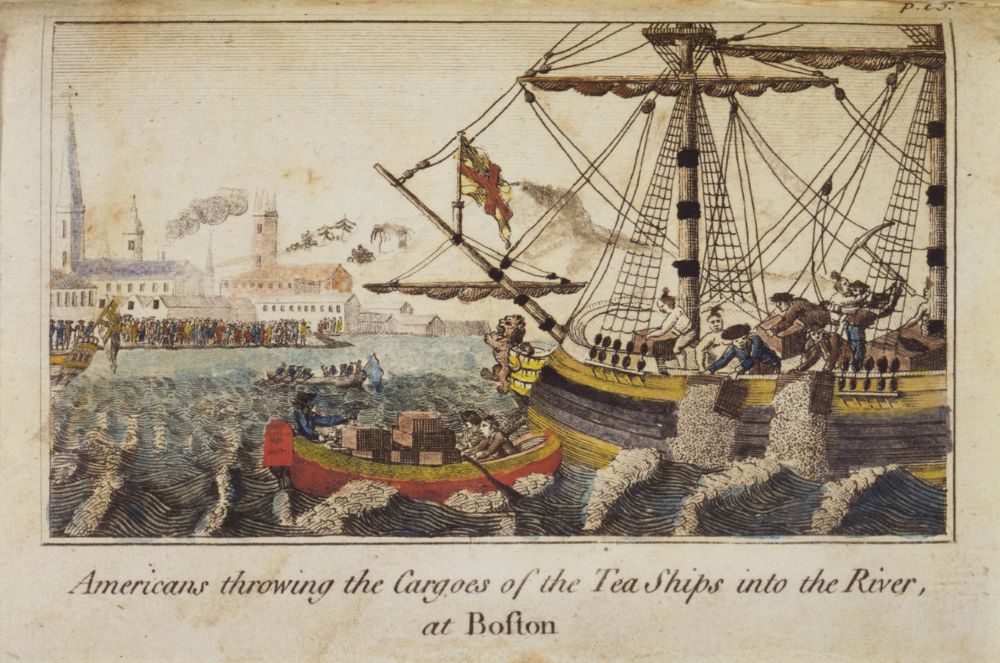
Appalled by the protest, the British enacted punitive laws against Massachusetts, including closing Boston Harbor until compensation was made for the destroyed tea. The move raised questions about the colonists’ right to self-government, engendered sympathy among the other colonies, and accelerated the path to war.
The port closure turned Boston Harbor into a battleground as both sides sought control of shipping and shoreline access.
Paul Revere
By the spring of 1775, Royal Navy ships were anchored at numerous points around Boston and neighboring Charlestown. Thousands of British soldiers occupied the city, but reaching the mainland from Boston’s isolated peninsula required a long march south or a massive flotilla of boats crossing the shoals that would later become Boston’s Back Bay. They decided to go by boat, and Paul Revere was sent ahead to warn of their march into the countryside. To make his famous ride, Revere also began with a boat trip across the harbor. Leaving Boston at night, he silently slipped past the massive 64-gun ship anchored between Boston and Charlestown and rode on to warn the American forces of the British march toward Lexington and Concord.
Stopping the Supply
Throughout the British occupation of Boston, the American army remained entrenched on the surrounding mainland, leaving the British dependent on supplies by sea. American troops also raided the British from small boats, seeking to intercept aid and destroy resources bound for the British.
In late May 1775, American soldiers were ordered to remove livestock from farms on Noddle’s Island and Hog Island in the harbor northeast of Boston. The farmers, despite reportedly supporting the American cause, were pressured to sell cattle, horses, wool, and hay to the British and feared retaliation from both sides.
Today, the small creeks that separated and distinguished Noddle’s and Hog Islands have largely all been filled in, and the islands themselves have disappeared into one large land mass forming part of East Boston and Logan International Airport.
An Attack from the Harbor
The American forces initially formed in Cambridge and marched north around the harbor, picking up additional forces from other colonies as it went. At about 11 a.m. on Saturday, May 27, the Americans, now numbering around 300, made their way from Chelsea to Hog Island, and a portion continued south to Noddle’s Island, where they began driving off horses, cattle and sheep. They then set fire to a large hay supply and the barn itself.
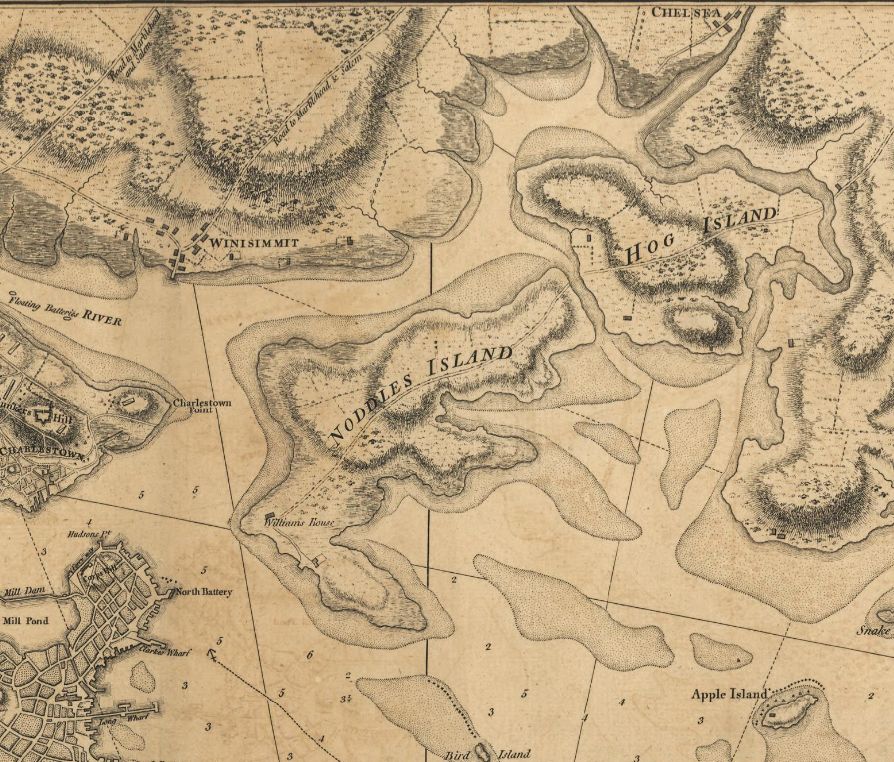
By mid-afternoon, the fires became visible to the British across the harbor, who ordered a contingent of Marines to the island and sent the schooner Diana to cut off the Americans’ retreat. The Americans successfully fled from the Marines in shallow whaleboats, but as Diana sailed up into the narrow Chelsea Creek, Americans began firing at the ship from the shore. At the same time, the wind began to die, and the flooding tide began to drive the schooner uncontrollably further into the shallows. Diana’s crew launched small boats and attempted to tow the ship out of danger, but the sustained fire from the Americans was too much. Despite returning fire, the longboats and ship’s crew were eventually forced to flee, leaving the schooner high aground on the mud flats.
The Americans set fire to the stranded British ship, creating an inferno that was visible to all the massive Royal Navy ships at anchor in the harbor, but to which they were powerless to respond.
The Battle of Chelsea, as it became known, reinforced the importance of control over the Harbor and its myriad waterways. It was the first time American forces from different colonies fought together and showed the effectiveness of disrupting British supply lines.
Bunker Hill
Only a month later, the Americans learned the British were planning to fortify the hills of Charlestown with guns that would allow them to defend their control of the harbor from land. To prevent that, American troops moved from the north down the Charlestown peninsula and into position on Bunker and Breeds Hills. Seeing the Americans had fortified the hills, the British attacked from the harbor, landing troops at Charlestown. The Battle of Bunker Hill forced an American retreat from Charlestown, but devastating British losses prevented further advances into American-controlled territory.
Dorchester Heights
Having lost oversight of the harbor from Bunker Hill, the Americans turned their attention to the south side of the harbor. The hills at Dorchester Heights offered even better oversight of the harbor than Charlestown. In March 1776, the Americans fortified the Heights with cannon seized and hauled from Fort Ticonderoga in New York. The guns prevented the British from receiving supplies and aid from incoming ships, and an assault on the steep hills risked British losses worse than those at Bunker Hill.
As a result, the harbor was lost to the British and with it, the city of Boston. Within a couple weeks, after some negotiation over safe passage, the British army retreated from Boston by ship, sailing for Halifax, Nova Scotia, along with about 1,000 British loyalists.
Harbors in New York, Newport, and Charleston would become the settings of similar battles, with varying results, for control of the waterfront during the Revolution. With the arrival of French support in 1778, larger naval forces also joined in, fighting over control of the Chesapeake Bay, and taking the fight to the Royal Navy in the Caribbean. Through it, Boston and its harbor remained in American control, serving as a hub for critical supplies and a dockyard refuge for both the French and Continental navies.
The Author(s)
Carl Herzog
Public Historian, USS Constitution Museum
Carl Herzog is the Public Historian at the USS Constitution Museum.


