



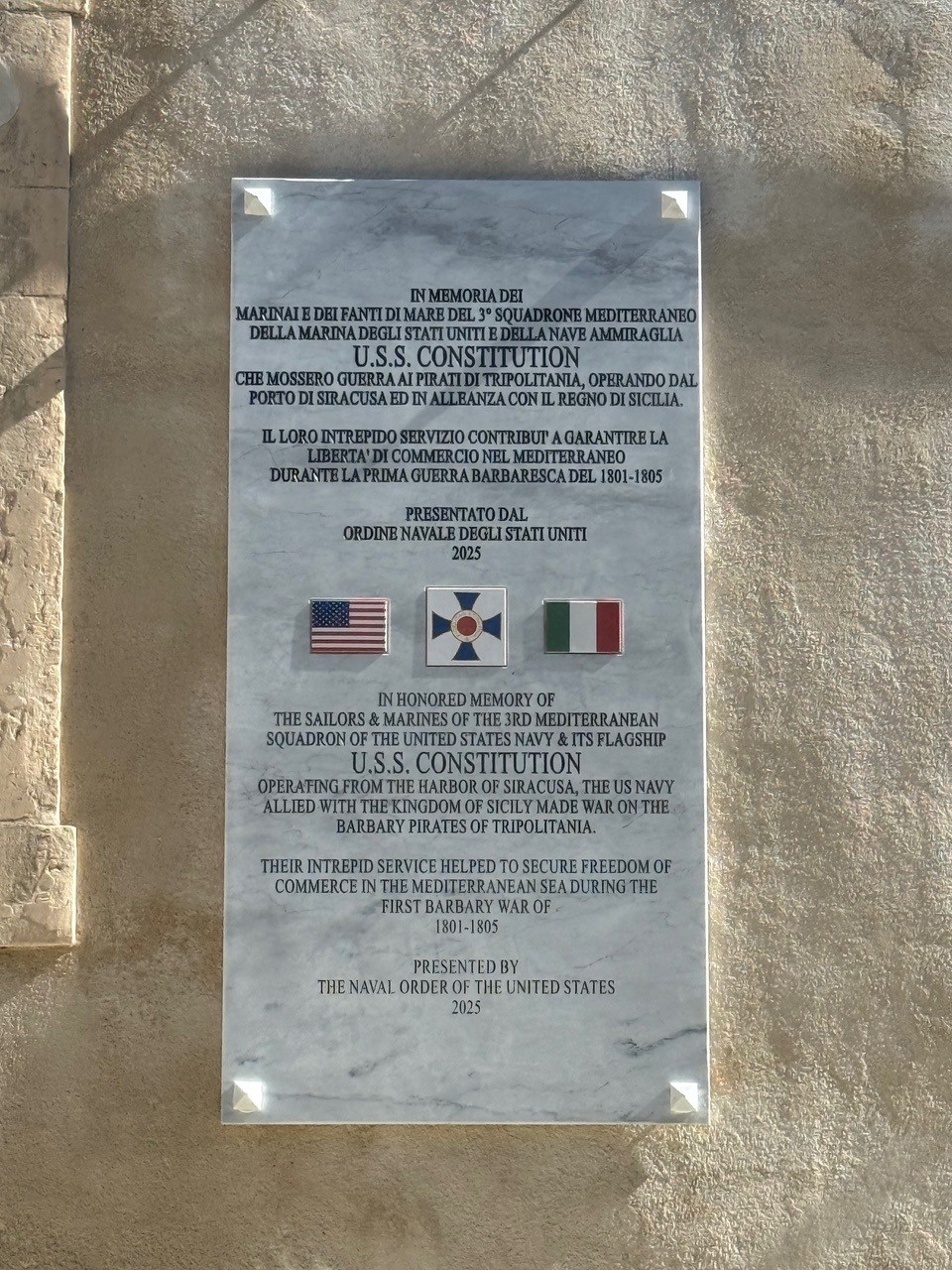
At the Museum of the Sea in Syracuse, Italy, on the island of Sicily, a large plaque was recently erected to commemorate the U.S. Navy’s Mediterranean Squadron of the early 1800s and specifically the squadron’s flagship, USS Constitution.
Located at the narrowest point in the Mediterranean Sea, Sicily was a critical strategic base in the American war against the Barbary states of North Africa, and the United States counted the Kingdom of Sicily as an ally in the war. But even after that conflict was resolved, USS Constitution remained a regular sight throughout Sicily and mainland Italy. Between 1803 and 1850, Constitution made dozens of visits to the ports of Syracuse, Messina, and Palermo in Sicily, as well as Livorno in Tuscany, Naples, and others.
Italy’s maritime connection to the United States was born not just from its geographic location, but from the extensive trade that Americans conducted with several of the Italian kingdoms beginning before the American Revolution – trade which the United States was eager to safely resume in the decades after independence. Protecting that trade, even in times of relative peace, led the United States to maintain a Mediterranean Squadron with a constant presence throughout the first half of the 19th century. Constitution and other U.S. Navy ships were so omnipresent in Italian ports throughout numerous multi-year deployments that USS Constitution enlisted Italians as members of the crew on several occasions.
The Italian Hub
In its first decade as an independent nation, the United States struggled to regain a foothold in trade on the world stage. Not only had newly sovereign American merchant ships lost the protection of the Royal Navy, but Britain also saw the United States as a new competitor in the global markets and attempted to thwart its trade prospects.
When Britain and France returned to war against each other at the height of the French Revolution, Americans insisted on remaining neutral, hoping to continue trading with all of Europe. Livorno, widely known as “Leghorn” in English, had long been a key trading entrepot into Europe. It was the primary port for Florence and was designated as a free port by Tuscany in the 1600s. In the decades prior to the American Revolution, American merchants brought dried fish and flour from the colonies into the port. But in the 1790s, Americans were now re-exporting goods through Livorno, mostly tropical commodities like sugar, coffee, pepper, and logwood from other nations’ colonies.
Mediterranean Chokepoint
American ships bound for Livorno and other Italian ports were among those that the Barbary States of North Africa began seizing after the Revolution, demanding tribute for safe passage and imprisoning American crews until they were paid. The United States decided in 1794 to fund the creation of a standing Navy to fight the Barbary corsairs, but short-lived diplomatic solutions postponed a military conflict until 1801.
For U.S. naval ships, Sicily was an ideal base for mounting attacks on the corsairs and protecting American commerce. Centrally located in the Mediterranean, the island is less than 80 miles north of the North African coast and easily accessible from east and west. From there, USS Constitution and the other U.S. Navy ships could easily patrol the breadth of the North African coast, but particularly Tripoli and Tunisia.
The Kingdom of Sicily was also friendly to U.S. interest. It served as an admiralty court for American seizures of ships and contracted out smaller ships to the U.S. forces for tracking down the pirates in shallow inshore waters.
Sicilian Pilot
When Edward Preble arrived on USS Constitution to take command of the Mediterranean Squadron in 1803, he knew he would need a pilot with local knowledge for navigating into Tripoli. In Sicily, he found Salvatore Catalano, a ship captain and pilot with extensive experience along the North African coast.
After the U.S. frigate Philadelphia was captured by the Tripolitans, Catalano became a crucial element in Preble’s plan to destroy the ship before it could be refitted and sent into service for the Tripolitans. Catalano’s role in the success of the mission earned him a permanent place in the U.S. Navy, and he eventually emigrated to the United States where he spent more than 40 years working in the Washington Navy Yard.
Keeping the Peace
After the Barbary War, the United States decided to maintain a naval presence in the crucial Mediterranean. The peace further augmented American trade with the Italian kingdoms and other European, African, and Middle Eastern ports. In 1807, 152 American ships called at Livorno alone, carrying 4.2 percent of the total American exports to everywhere that year.
As the naval squadron shifted to a peacetime role, its responsibilities, activities, and tasks became more diversified and dynamic. Constitution and other warships spent more time in ports of call, often working with regional consuls and participating in ongoing diplomacy.
Italian Musicians
Diplomatic, ceremonial, and social duties necessitated a new addition to the ship’s complement, a musical band. In Sicily, Constitution hired an entire Italian band to accompany it through a two-year squadron assignment. The members of the band that served from 1848 to 1851 were considered members of the crew and listed by name on the ship’s muster rolls. The band performed salutes for other ships, foreign officers, and dignitaries, and played at formal balls held both on board and on shore.
Visit from the Pope
In the 1840s, the Italian kingdoms experienced a turbulent series of revolts that ultimately lead to their unification as a single Italian state. The movement was part of a broader European revolt against monarchy in favor of constitutional democracies. In Rome, the revolts targeted the Papal States. In the summer of 1849, after the Minister of Justice for the Papal States was assassinated, Pope Pius IX fled Rome to take refuge in the coastal town of Gaeta. There, on August 2, the Pope visited the ship at anchor.
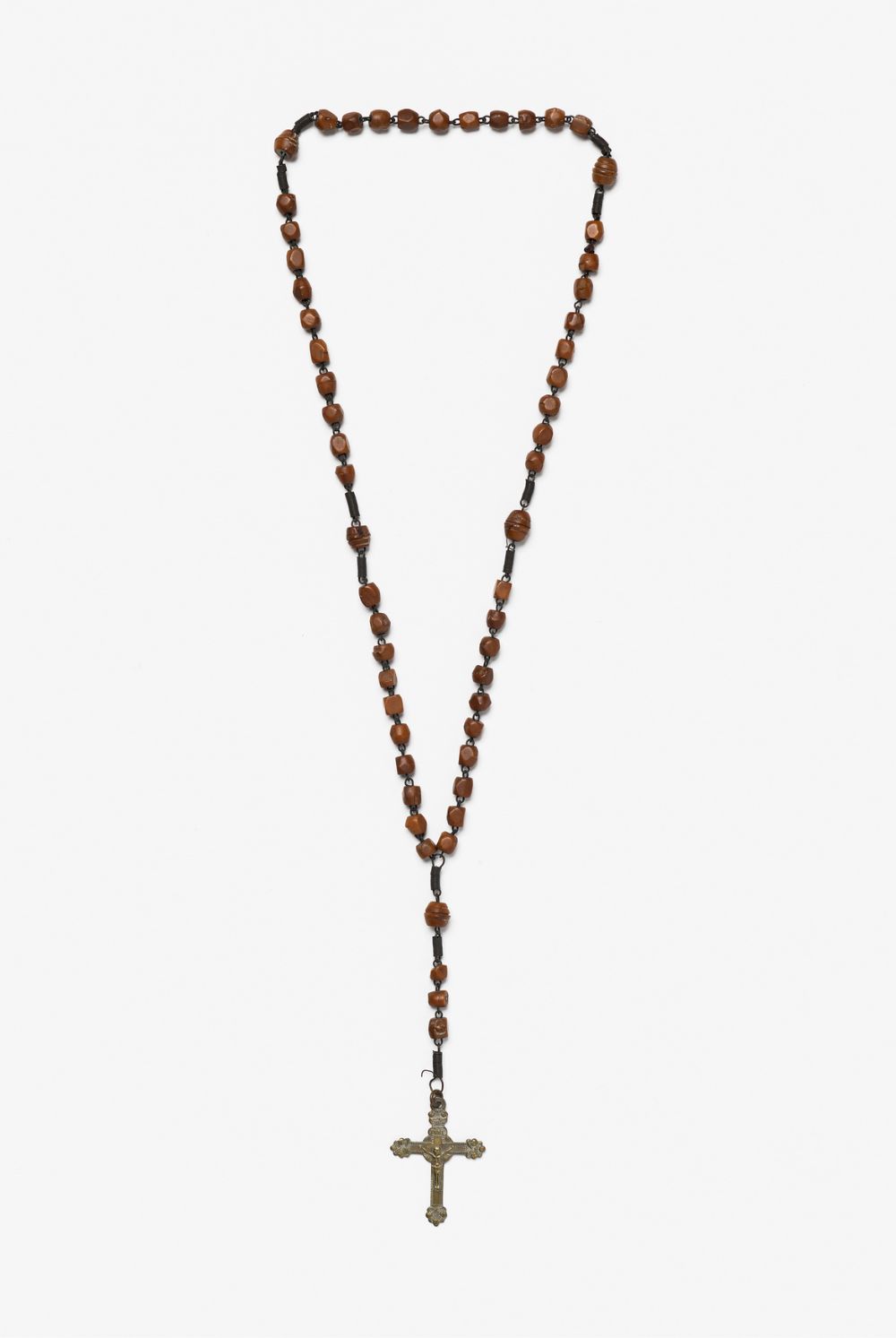
Because a nation’s warships are considered sovereign territory, Pope Pius IX’s visit is technically the first time a Pope set foot on United States territory. He provided a blessing to the Catholic members of the crew and handed out rosaries. However, this formal visit by the Pope and his cardinals, accompanied by the King of Naples, who was sheltering the Pope, was not authorized. Constitution’s Captain John Gwinn allowed the visit under pressure from Naples, subsequently placing the United States in a precarious position. While ordered to protect American commerce and pursue pirates that might threaten American merchant ships, the Navy was to maintain a position of strict of neutrality in the ongoing revolutions. The full honors accorded the Pope and the King implied support for the existing governments, and the U.S. Navy Department was not pleased with Gwinn’s actions.
An Enduring Connection
USS Constitution’s last extended deployment to the Mediterranean ended in 1851, but U.S. Navy presence there, still based out of Italy, continues through today. The Mediterranean Squadron was reorganized in 1865 with a smaller presence but expanded again dramatically in the 20th century. Since the end of World War II, the Navy’s Sixth Fleet, responsible for the Mediterranean basin, has been headquartered in Naples.
The Author(s)
Carl Herzog
Public Historian, USS Constitution Museum
Carl Herzog is the Public Historian at the USS Constitution Museum.


