



As construction of USS Constitution began in earnest in 1795, one question remained about the ship’s design: What would be the ship’s figurehead?
The practice of mounting a detailed carving of a mythic figure on a ship’s bow goes back thousands of years. Originally a totem of strength and protection, figureheads came to embody the perceived essence of the vessel. In the 17th century, more elaborate sculptures on both the bow and stern became common, particularly among naval ships, royal barges, and other ships representing political states. Ships named for actual people usually had figureheads depicting the namesake.
For USS Constitution, representing one of the new powerful frigates of the United States Navy and named for the nation’s founding document, the question was more complicated. The answer came from William Rush, a highly regarded ship carver in Philadelphia, who wrote to Constitution’s designer, Joshua Humphreys, in April 1795 proposing the ship be adorned with the Roman god of strength, Hercules:
“As the Constitution of the Empire is the result of the Union of the States, and Union begets Strength, it ought to be represented by an Herculean figure, standing on the firm rock of independence, resting one hand on the fasces which was bound by the Genius of America, and the other hand presenting a scroll of paper, supposed to be the Constitution of America, with proper appendages, the foundation of Legislation.”1
Rush ended up designing Constitution’s figurehead, as well as those of the other initial five frigates of the U.S. Navy. He recommended to Secretary of War Timothy Pickering that John and Simeon Skillin of Boston be hired to carve Constitution’s Hercules. The collaboration between Rush and the Skillin brothers brought together the two most illustrious names in American shipcarving for USS Constitution’s figurehead.
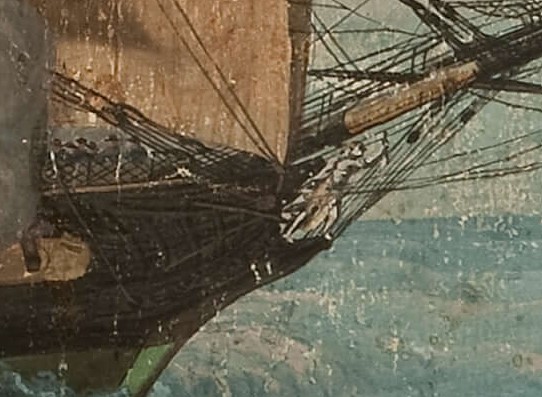
It was no small claim. Shipcarvers, specialists in creating figureheads, decorative scrollworks, and stern carvings for ships, had boomed alongside the shipbuilding industry, first in the American colonies and again after the American Revolution. Dozens of full-time shipcarvers were working in the nation’s seaports along with untold numbers of additional carvers who used the art to supplement other woodworking and shipbuilding jobs. In addition to figureheads, carved scrollwork and relief figures were common on ships’ sterns and quarter galleries, even on small ships.
While many of the shipcarvers operated as simple craftsmen or artisans, Rush and the Skillin family elevated their careers both in style and function. They transformed the nature of ship’s figureheads while also moving beyond ships into dynamic public statuary, earning recognition from many art critics as America’s first true sculptors.
William Rush, The Designer
Born in Philadelphia in 1756, William Rush initially followed in his father’s business as a shipbuilder but was soon apprenticed to a shipcarver in town. After the outbreak of the American Revolution, Rush set up his own workshop in Philadelphia and began producing figureheads and other carving for American privateers. With a boom in shipbuilding after the war, Rush continued to produce figureheads for new American merchant and whaling ships, as well as commissions for other ships in Europe and North Africa.
While ships’ figureheads were traditionally stiff and formal, Rush developed a new style that sought to evoke fluid, lifelike motion and more elaborate symbolic adornments than in earlier figures. In ports around the world, Rush’s work began to attract extraordinary attention whenever his customers’ ships sailed in.
This innovation led the federal government to select Rush to design the figureheads for all six frigates authorized for the new U.S. Navy in 1794. He would ultimately carve four of them himself.
Although none of the original works have survived, descriptions suggest his most elaborate design was for the frigate USS United States. It featured a female figure that embodied the United States, clutching a carved portrait of George Washington to her chest in one hand and holding a spear in the other, while a belt of wampum adorned her, represented symbols of peace and war. At her side was a tablet supporting three columns representing the branches of government. Blending into the columns was a scale representing justice, with the U.S. Constitution on one side and an eagle with the shield representing the arms of the United States on the other.
In addition to the Hercules figurehead for USS Constitution, Rush produced another Hercules in 1799 for the frigate USS Philadelphia. This one showed Hercules swinging a club over his head to slay the seven-headed hydra. The body of the hydra at his feet merges into the trailboards for the bow, with the dragon’s tail curling along with the other scrollwork.
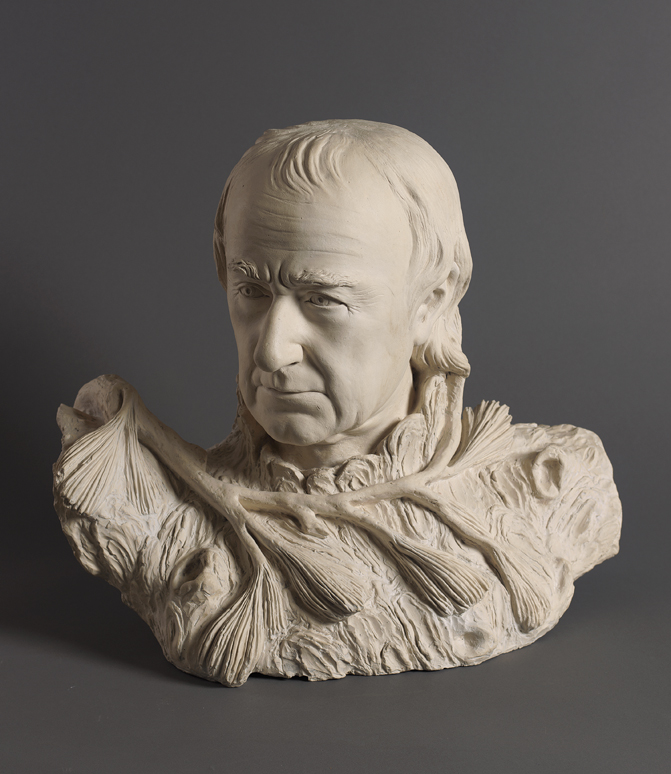
In the early 1800s, Rush began to find commissions for his mythic and allegorical figures in public spaces, beginning with a Philadelphia water supply agency who commissioned a sculpture of a Greek water nymph for a pumphouse. The rise of interest in Greek- and Roman-inspired public art continued to bolster his career. In a self-portrait bust he carved in the 1820s, Rush depicted himself seemingly growing from a pine trunk with a branch adorning his shoulders.
Rush died in Philadelphia in 1833.
Skillin Brothers, The Carvers
Rush recommended the Navy hire the Skillen Brothers to carve his design for Constitution’s Hercules. It was not a tepid suggestion.
By 1796, John Skillin and his brother, Simeon Skillin Jr., were running Boston’s most prominent shipcarving workshop. They either employed or had previously employed most of Boston’s shipcarvers. As Rush would do later, the Skillin brothers had already branched out into public statuary, developing a reputation as genuine artists and sculptors.
The Skillin brothers were the legacy of a shipbuilding and shipcarving family. Their grandfather, John Skillin, was a shipwright who came to Boston from Portsmouth, New Hampshire, seeking work. With him was his son, Simeon Skillin, Sr., who likely followed his father’s vocation initially, but was soon apprenticed to a Boston shipcarver. Through the mid-1700s, Simeon, Sr. developed a reputation for carving figureheads for merchant ships. Three of his five children followed in his vocation: Samuel Skillin apprenticed in Boston, then practiced in Philadelphia before returning to Boston to open a shop on North Bennett Street.
In the meantime, John and Simeon, Jr. created a workshop that became known as Skillings Wharf, located on the Boston waterfront roughly between today’s Commercial and Lewis Wharves.
Like Rush, their business grew dramatically during the American Revolution and afterwards shifted easily to merchant ships. The grandeur of their work on ships transferred seamlessly to public projects. Among their many works, the brothers produced a statue of the Roman god Mercury for a new Boston post office and a female embodiment of “Hope” for the Custom House, and other Greek and Roman figures for both public and private spaces.
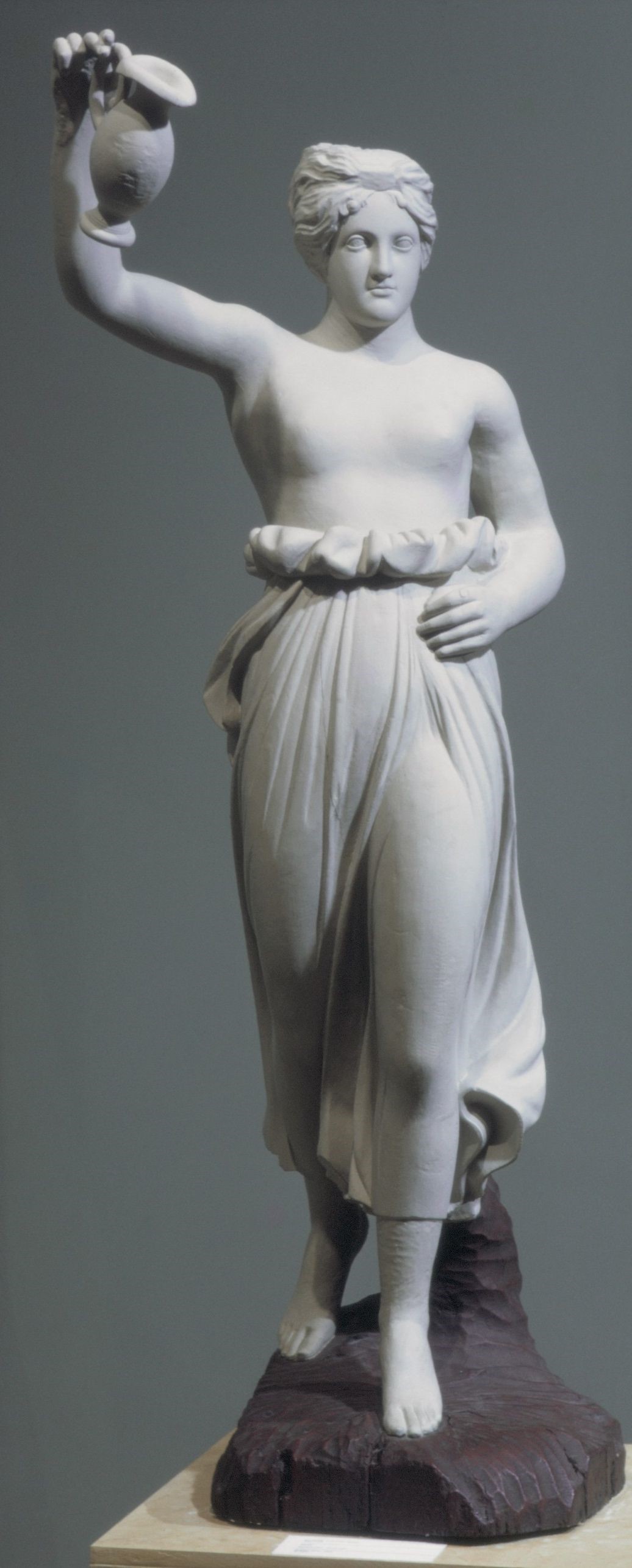
They produced statues and busts of merchants and other prominent people, but they also produced smaller allegorical and mythical figures to adorn high-end furniture. Unlike their ship’s figureheads, much of this artistic and furniture work still survives in museums, galleries, and private collections.
John Skillin died in 1800. Simeon Skillin, Jr. continued to manage the workshop until his death in 1806.
Hercules’ Fate
Despite the prominence of its creators, Constitution’s Hercules figurehead did not last long.
On September 12, 1804, in the central Mediterranean, Constitution and USS President collided when President became backwinded by a sudden wind shift. As the two ships became entangled and swung around together, President’s hull crashed through Constitution’s bowsprit and figurehead.
By the time the ships separated, there was nothing left of Hercules to repair. In Malta, the remains of the figurehead were cut away and the carpenters replaced it with a simple billethead – a scrollwork that extended down the cutwater section of the bow.
The expense and weight of elaborate figureheads were beginning to render them impractical and out of fashion at that point. USS Constitution retained some variety of billethead and scrollwork until 1833, when a highly contentious figurehead of Andrew Jackson was installed.
1 William Rush to Joshua Humphreys, 30 April 1795. Humphreys Papers, Historical Society of Pennsylvania, as quoted in “Notes and Queries”, Pennsylvania Magazine of History and Biography, Vol. 31, issue 2, 1907, 239-240.
___________________
Sources
M. V. Brewington, Shipcarvers of North America (Dover Publications, 1972)
Sylvia Leistyna Lahvis, “Icons of American Trade: The Skillin Workshop and the Language of Spectacle,” Winterthur Portfolio 27, no. 4 (1992): 213–33.
Arthur S. Marks, “Joining the Past to the Present: William Rush’s Emblematic Statuary at Fairmount,” Proceedings of the American Philosophical Society 157, no. 2 (2013): 176–228.
Laura Turner Igoe, “‘Appropriate in a Sylvan State,’” American Art 28, no. 1 (2014): 78–103.
The Author(s)
Carl Herzog
Public Historian, USS Constitution Museum
Carl Herzog is the Public Historian at the USS Constitution Museum.


