


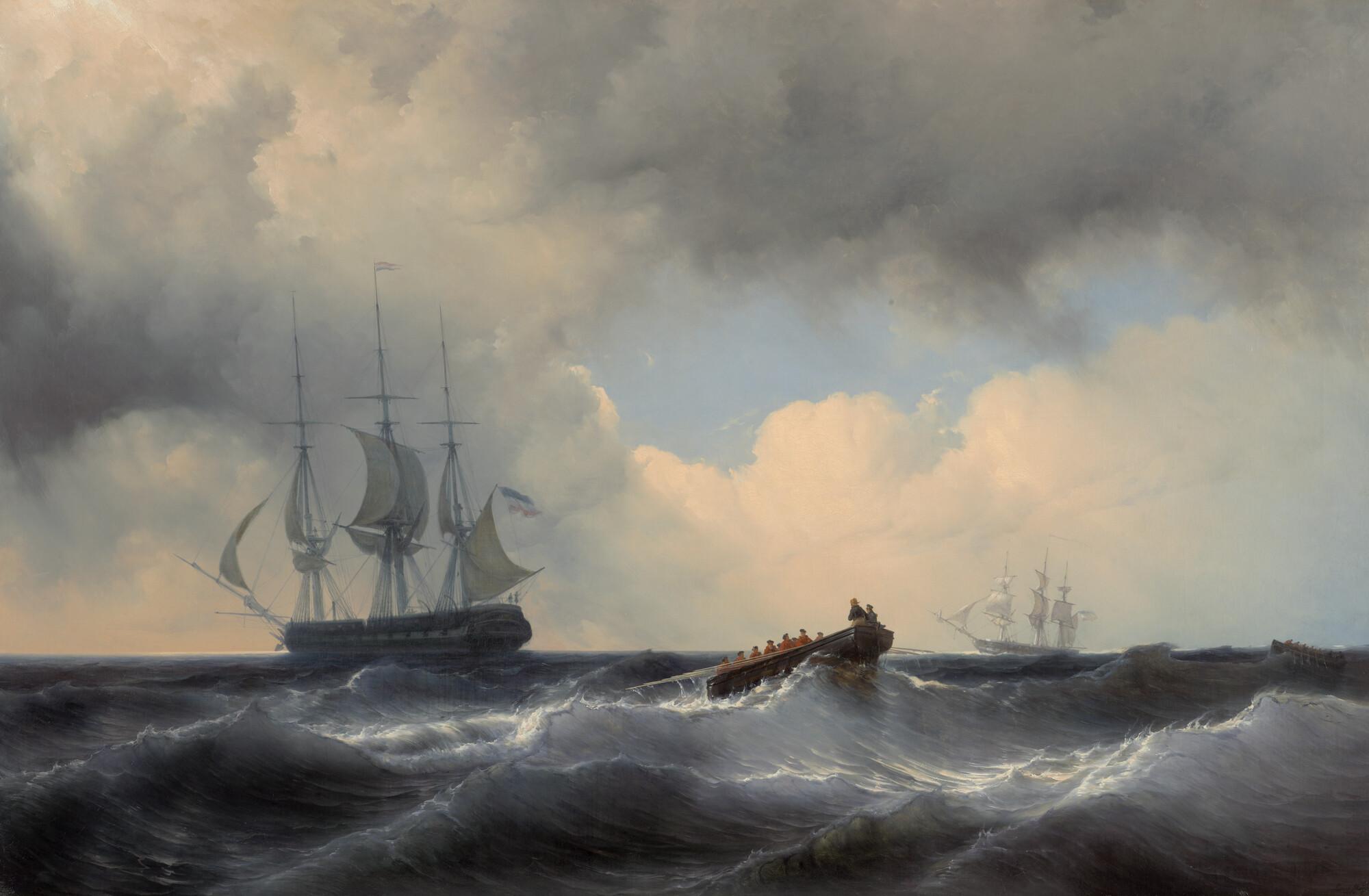
A fresh breeze blew out of the east, funneling through the Strait of Gibraltar and along the African shoreline on the morning of September 25, 1803. North of the harbor at Tangiers, USS Constitution was reaching back and forth under reefed sails, patrolling the Atlantic Ocean side of the entrance to the Mediterranean, where Barbary corsairs had been seizing American merchant ships.
That’s when seaman Robert Burrell fell overboard.
It’s not clear where exactly on the ship Burrell was at the time, what he was doing, or exactly how he managed to go over the side. But the response was quick. A small boat was launched and Burrell was safely retrieved.
Hours later, the scene repeated itself when seaman Joseph Marlet fell overboard, and the boat was launched again to retrieve him. Although, in Marlet’s case, the rescue may have taken longer as the ship was charging along at nine knots of speed. Like Burrell, it’s not clear what Marlet was doing when he fell.
To suffer two men overboard in a single day in relatively benign conditions was extraordinary. To safely recover both while underway was even more unusual.
Over the course of Constitution’s active sailing career, 12 crew members died from falling overboard and another seven were rescued after falling overboard. Some fell from the rigging, others from the deck. Some fell while coming on or off the ship at anchor in nice weather. Others fell while the ship was underway in heavy weather.
The Response
Whenever possible, the response to a man overboard was to launch a small boat in an effort to rescue the person or, if conditions were too rough, to attempt to maneuver the ship close enough to get a line to the person in the water.
USS Constitution carried about six small boats of various sizes and functions during most of its active sailing career. In the cases of Marlet and Burrell, the boat launched to rescue them was the “jolly boat,” a roughly 20-foot boat propelled by four or six oars and designed for ferrying crew ashore and between vessels. Though often carried on the stern davits, the “jolly boat” could also be launched from the quarter davits, which allowed it to more safely launch while the ship was moving.
At the beginning of the 1800s, many ships started carrying early versions of liferings, buoyant devices designed to keep a person afloat. Accounts from Constitution indicate their use in later squadrons and on the ship’s circumnavigation of the globe in the 1840s. The lifebuoys hung over the transom and were designed to be quickly cut away, providing a flotation aid for the victim.
A lifebuoy saved the life of James Corbett, who fell overboard in July 1844, as the ship was departing Tenerife. After the buoy was deployed, Corbett swam to it and stayed afloat while the ship hove-to and launched a small boat to rescue him. Going 8 knots at the time of his fall, Constitution was a mile and a half away before the rescue could be launched.
While the circumstances of Constitution’s man overboard incidents vary, several factors seem to indicate the likelihood of someone surviving or not.
Falling From Aloft
The height of the fall was a factor. While some falls from rigging were survivable, a fall from higher yards tended to result in death. Although the logbooks rarely specify details, falls from greater heights were more likely to cause serious injury upon impact or, at the very least, render victims unconscious and increase their risk of drowning. Likewise, falling from upper yards increased the likelihood of striking lower yards or rigging, further reducing the chance of survival in the water. Luck and circumstances played a role.
In May 1823, John Richards was lost in the Mediterranean after falling overboard from the mizzen topgallant yard, a height of more than 100 feet above the water. However, in May 1840, Seaman Henry Peterson fell overboard from the same yard and was rescued.
In March 1878, Ordinary Seaman George H. Young died after falling overboard from the bowsprit while stowing the fore topmast staysail. The ship was battling a gale in the English Channel at the time and was unable to lower a boat or quickly turn around. The lifebuoys were deployed and, by one account, Young survived the initial fall but was unable to make it to the buoy. Though the bowsprit was lower in height, working there posed its own dangers as any man overboard could be immediately run over by the ship.
Being on deck did not eliminate the chances of being thrown overboard by the ship’s rigging, but it increased the likelihood of rescue. As Constitution was departing Gaeta, Italy, in 1849, Midshipman George Chapman was knocked overboard by the main bowline and recovered by boat. The ship was working to windward at only 3 knots in a moderate breeze at the time. Similarly, departing Tunis in 1853, Henry Panford was knocked overboard by the main sheet and rescued.
Time & Light
While the ship’s logs do not record the exact times of every man overboard incident, both Richards and Young shared the misfortune of falling overboard late in the day, when fading light made spotting victims more difficult and launching a small boat more dangerous.
Simple Slips
Some of the falls overboard occurred in the most benign of sea conditions and operating circumstances. Sailors fell into the water while getting on and off the ship at anchor or alongside a wharf. Others fell from the deck or the channels, the platforms extending over the water that support the shrouds at deck level. While complacency may have contributed to some incidents, others may have resulted from unavoidable slips.
In April 1853, while the ship was at anchor in Spezia, Italy, Marine Private John Robinson slipped and fell from the ship’s gangway. Though he was quickly recovered, he lost his musket in the fall.
Other Falls
Though not counted as a man overboard incident, sailors sometimes fell from the rigging onto the deck below. In these situations, surviving victims could be more readily treated, but the falls were more often fatal. Twelve Constitution sailors died falling from aloft to the deck, and two more were killed in falls through open hatches.
Modern Responses
On modern naval and commercial ships, the risk of a crew member falling overboard still demands vigilance and training to ensure an effective response. Although shipboard responses have changed little since the 1800s, support from helicopters and other shore-based search and rescue assets extends and strengthens the search and recovery efforts.
Safety measures to prevent falls overboard have also improved. Crew members working on open decks or in precarious positions often wear lifejackets, while those working aloft on sailing ships, including Constitution, wear safety harnesses designed to prevent falls.
The Author(s)
Carl Herzog
Public Historian, USS Constitution Museum
Carl Herzog is the Public Historian at the USS Constitution Museum.


